FI | EN
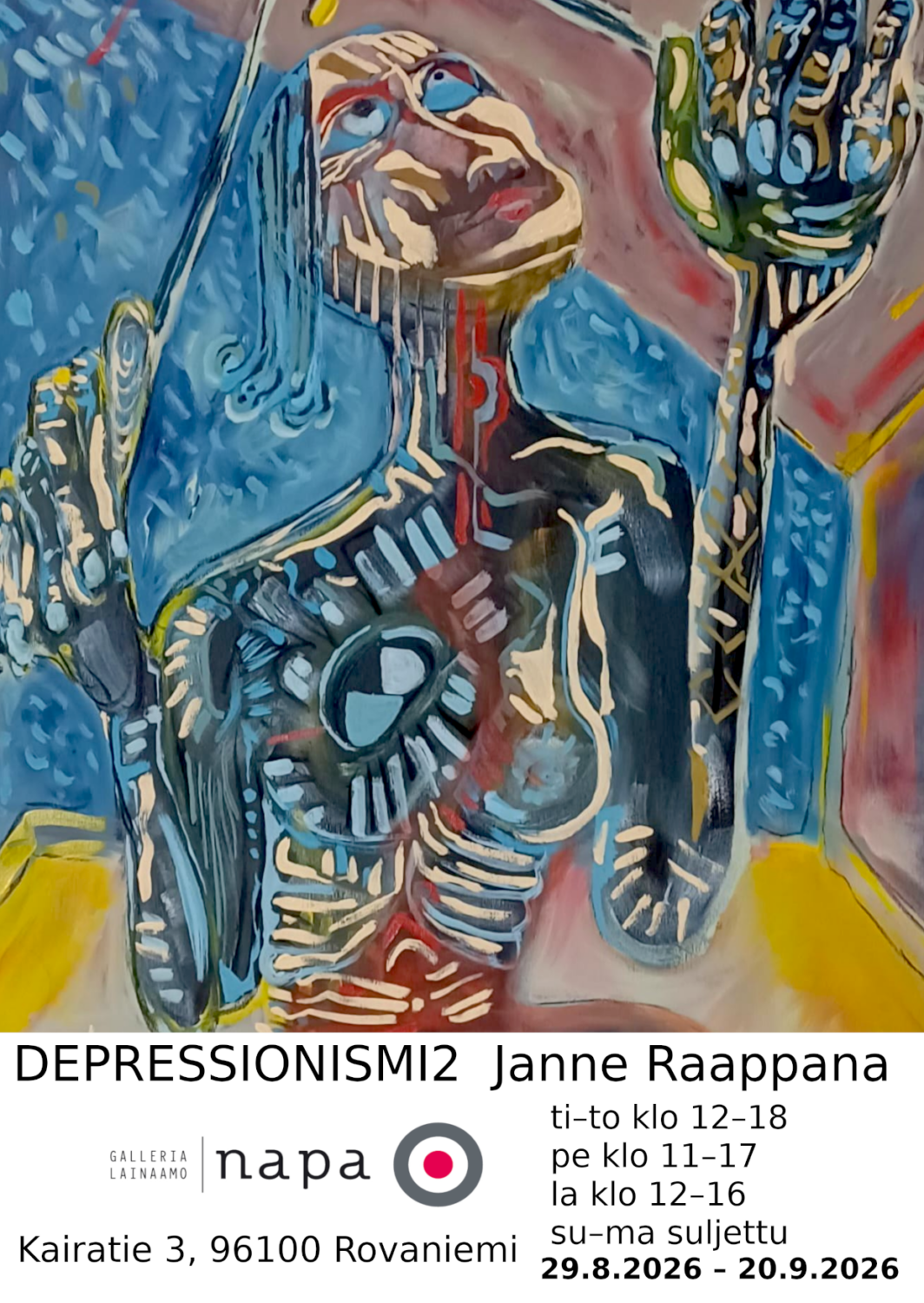
Janne Raappana – DEPRESSIONISMI 2
Galleria Napa 29.8.2026 – 20.9.2026
Depressionismi muodostuu…
Olen äänitaiteilija ja abstrakti ekspressionistinen taidemaalari. Taiteellisessa työskentelyssäni ääni, maalaus ja installaatio muodostavat kokonaisuuden, jonka kautta tarkastelen ihmisen sisäistä maailmaa, ympäröivää yhteiskuntaa ja näiden välistä jatkuvaa vuorovaikutusta. Työskentelyni lähtökohtana on ajatus siitä, ettei taide ainoastaan kuvaa todellisuutta, vaan voi muuttaa tapaa, jolla todellisuus koetaan, ymmärretään ja muistetaan.
Taiteellinen ajatteluni on kehittynyt useiden vuosien aikana, ja vuodet 2020–2026 muodostavat siinä erityisen selkeän kokonaisuuden. Vuoden 2020 pandemia, sitä edeltäneet yhteiskunnalliset ja ekologiset kriisit sekä viime vuosien sodat, poliittinen epävakaus, informaatiotulva, propaganda ja todellisuuden jatkuva vääristyminen ovat muuttaneet sitä, miten tarkastelen ihmisen asemaa maailmassa. En pyri kuvaamaan näitä ilmiöitä suoranaisesti tai tekemään niistä dokumentaarisia teoksia. Minua kiinnostaa ennen kaikkea se, mitä tapahtuu ihmisen kokemukselle niiden keskellä.
Vuonna 2020 taiteellinen työskentelyni liittyi vahvasti pandemian synnyttämään eristyneisyyteen, epävarmuuteen ja pelkoon, informaatioon ja disinformaatioon. Näin ympärilläni tilanteen, jossa totutut sosiaaliset rakenteet muuttuivat nopeasti ja ihmisten käsitys turvallisuudesta, yhteydestä ja tulevaisuudesta järkkyi. Äänitaiteessa tutkin näitä kokemuksia immersiivisten äänimaailmojen kautta. Ääni mahdollistaa kokemuksen, joka ei tarvitse kielellistä selitystä. Se voi välittää jännitettä, ahdistusta, hiljaisuutta ja epävarmuutta suoraan aistillisena kokemuksena. Luonnon ääni on kadonnut.
Samalla abstrakti maalaaminen tarjosi minulle toisen väylän saman ilmiön tutkimiseen. Väri, pinta, viiva, kerroksellisuus ja muoto toimivat eräänlaisina sisäisen kokemuksen jälkinä. Maalaus ei ole minulle kuva jostakin ulkoisesta tapahtumasta, vaan tapahtuma itsessään. Se voi muodostaa kartan mielestä, tunteesta ja tietoisuudesta tilanteessa, jossa ulkoinen todellisuus aiheuttaa jatkuvaa painetta.
Vuoteen 2023 mennessä tämä työskentely oli kehittynyt Depressionistiseksi taiteelliseksi ajatteluksi. Depressionismi ei tarkoita minulle yksinomaan masennusta, surua tai epätoivoa. Se on tapa tarkastella aikakautta, jossa yksilön sisäinen maisema joutuu jatkuvasti ristiriitaan ulkoisen todellisuuden kanssa. Siinä yhdistyvät kärsimys ja toivo, epävarmuus ja mahdollisuus muutokseen, yksilön kokemus ja laajempi yhteiskunnallinen todellisuus.
Depressionistisen ajatteluni keskeinen lähtökohta on ihmisen vieraantuminen sekä itsestään että ympäröivästä maailmasta. Tarkastelen sitä, miten kaupallisuus, teknologia, jatkuva informaation määrä ja yhteiskunnallinen paine vaikuttavat siihen, miten koemme todellisuuden. Samalla minua kiinnostaa luonnon ja kaupungin välinen jännite sekä ihmisen suhde omaan ympäristöönsä. Äänitaiteessa tämä voi ilmetä kaupunkitilan, luonnon, teollisen ympäristön ja ihmisen tuottaman äänen välisenä suhteena. Äänestä tulee materiaalia samalla tavalla kuin maalauksessa väri ja pinta ovat materiaalia.
Vuonna 2023 korostui vielä voimakkaasti ajatus rauhasta, toivosta ja yhteydestä. Näin taiteen mahdollisuutena purkaa rajoja ja tuoda esiin yhteisiä kokemuksia. Ajattelin taidetta keinona nähdä valheiden, vallankäytön ja hyväksikäytön taakse sekä löytää kokemuksellinen yhteys ihmisten väliltä. Ääni ja kuva olivat välineitä, joiden avulla pystyin tarkastelemaan ihmisen yhteistä surua ja kärsimystä, mutta samalla myös muutoksen mahdollisuutta.
Vuoteen 2026 tultaessa Depressionistinen ajatteluni on muuttunut yhteiskunnallisesti kriittisemmäksi ja samalla kokemuksellisemmaksi. Maailmaa määrittävät sodat, poliittinen epävakaus, propaganda, jakautiminen, informaatiotulva ja todellisuuden vääristely. Olen kiinnostunut erityisesti siitä, miten nämä ilmiöt vaikuttavat ihmisen havaintoon. En halua antaa katsojalle valmista tulkintaa tapahtumista, vaan tarkastella rakenteita, joiden kautta tapahtumat meille näyttäytyvät.
Tässä mielessä taiteeni ei ole tapahtumien kuvaamista vaan havaintojen tutkimista. Kysyn, kuka määrittelee sen, mitä pidämme todellisena, miten mielipiteitä muodostetaan ja millä tavalla jatkuva informaation virta vaikuttaa tunteisiin ja käyttäytymiseen. Propaganda ei vaikuta ainoastaan siihen, mitä ihminen ajattelee, vaan myös siihen, mitä hän pelkää, toivoo, muistaa ja jättää huomaamatta.
Äänitaiteessa tämä kysymys on erityisen olennainen. Ääni voi olla läsnä ilman, että sen lähde on näkyvissä. Se voi ympäröidä kuulijan ja muuttaa tilan kokemusta. Käytän ääntä materiaalina, jota voin kerrostaa, muokata, toistaa, hajottaa ja rakentaa uudelleen. Ääni voi muodostaa kokemuksellisen ympäristön, jossa merkitys ei synny yksittäisestä viestistä vaan suhteista, toistosta, häiriöstä, hiljaisuudesta ja tunnelmasta.
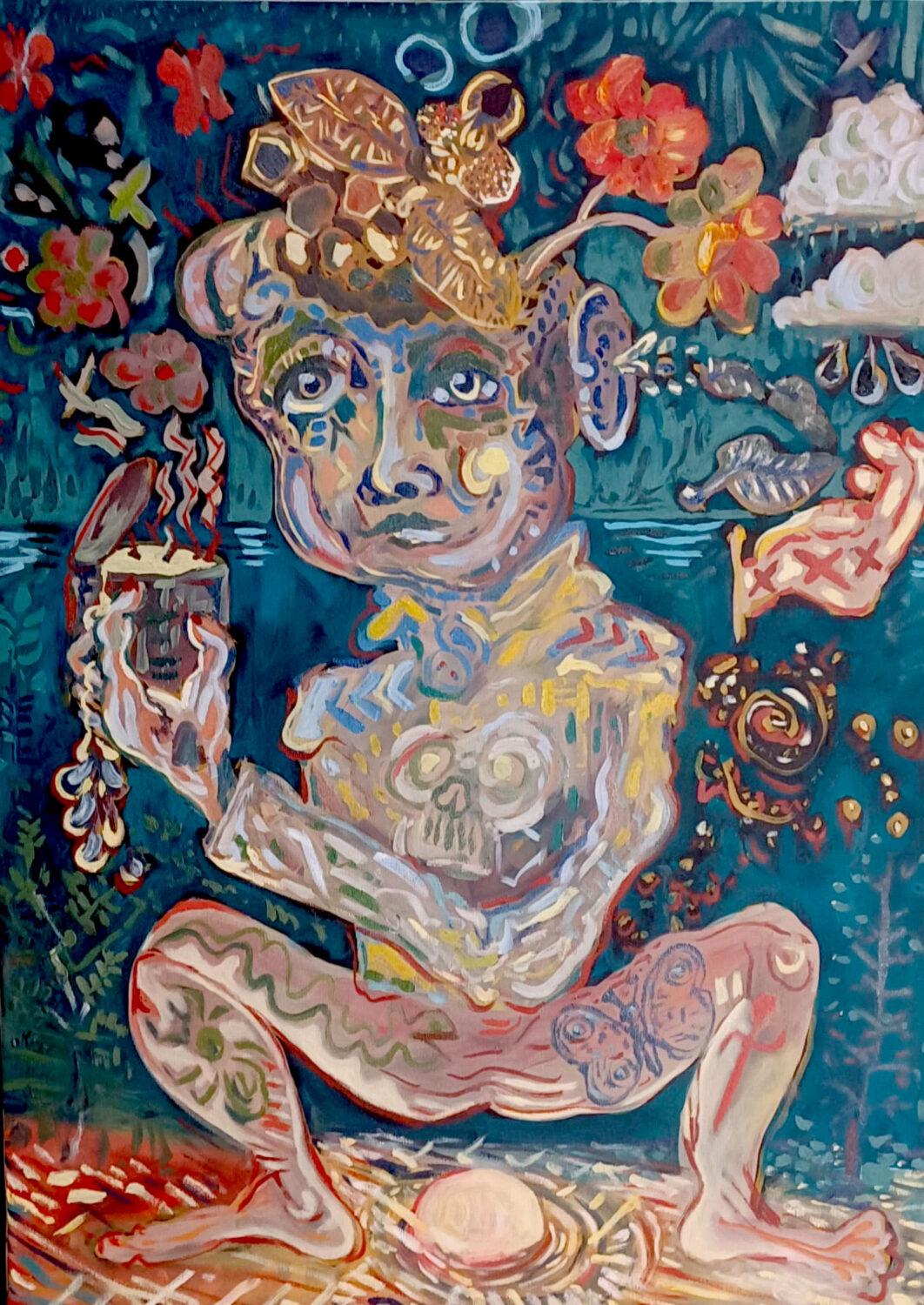
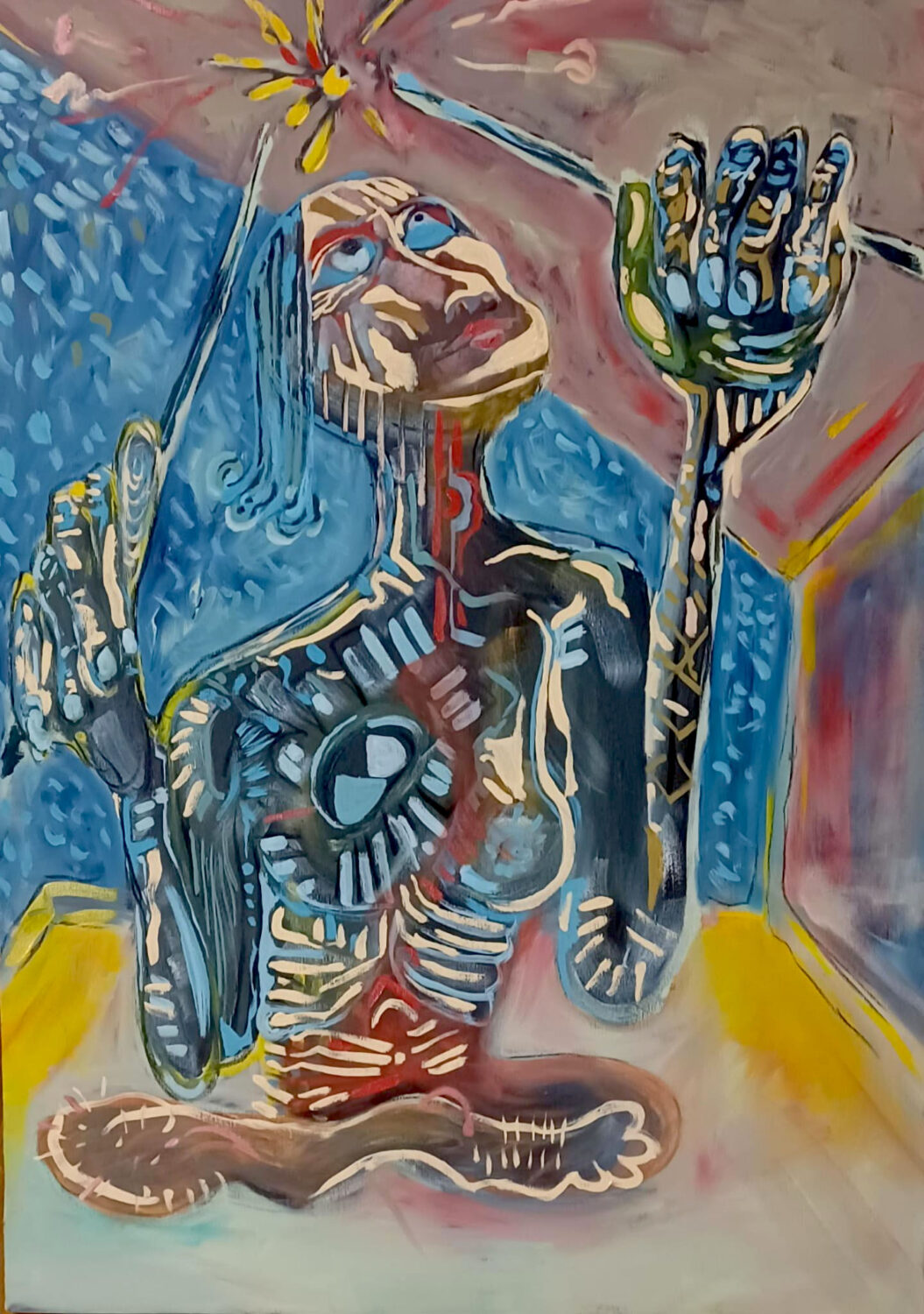
Maalaamisessa työskentelen vastaavasti abstraktion kautta. En pyri esittämään sotaa, propagandaa tai yhteiskunnallista kriisiä kuvallisina symboleina. Ne ovat läsnä maalauksissa kokemuksena. Värit, muodot, pinnat ja kerrokset voivat muodostaa sisäisen maiseman, jossa pelko, väsymys, epätoivo, energia ja selviytymisen tarve ovat samanaikaisesti läsnä. Kasvot ja hahmot voivat syntyä ja hajota maalauksen sisällä. Niissä kiinnostaa erityisesti tietoisuuden ja ympäristön välinen suhde: katsooko ihminen maailmaa vai onko hän itse jatkuvasti tarkkailun kohteena?
Depressionistinen työskentelyni ei siis ole pelkästään synkkää tai pessimististä taidetta. Sen tarkoituksena on tehdä näkyväksi ristiriita, jossa ihminen elää. Maailma voi olla samanaikaisesti uhkaava, absurdi, kaunis, koominen ja toiveikas. Myös huumorilla on tässä kokonaisuudessa paikkansa. En halua sulkea kokemusta yhteen tunnetilaan, vaan antaa ristiriitojen olla olemassa samassa teoksessa.
Ajattelen taiteen tilana, jossa ristiriitaa ei tarvitse ratkaista. Taiteen ei tarvitse antaa nopeaa vastausta tilanteessa, jossa yhteiskunta itsessään tuottaa jatkuvasti liian yksinkertaisia vastauksia. Minulle pysähtyminen, epävarmuus ja keskeneräisyys voivat olla kriittisiä toimintatapoja. Taide voi hidastaa havaintoa ja antaa katsojalle tai kuulijalle mahdollisuuden muodostaa oman suhteensa kokemukseen.
Työskentelyni on jatkunut pitkäjänteisesti eri näyttelyissä ja eri ympäristöissä. Äänitaiteella on ollut keskeinen asema esimerkiksi Porin Poriginal-gallerian Äänet vallassa -näyttelyssä, ja myöhemmissä teoksissa äänen ja abstraktin kuvan välinen suhde on edelleen syventynyt.
Nykyinen työskentelyni on jatkoa DEPRESSIONISMI 1 -näyttelylle, mutta samalla sen uusi muunnelma ja laajennus. En halua toistaa Porissa esitettyä kokonaisuutta, vaan viedä samaa ajattelua eteenpäin ja tarkastella sitä uudesta näkökulmasta. Aikaisemman näyttelyn teemat toimivat perustana, mutta uusi työskentely painottaa entistä enemmän havaintoa, informaatiota, vallankäyttöä ja yksilön sisäisen kokemuksen muutosta.
Taiteeni lähtökohtana on ajatus, että ääni ja kuva voivat paljastaa jotakin sellaista, mitä pelkkä kielellinen selitys ei tavoita. Taide voi tarjota kokemuksen, jossa ihminen ei vastaanota valmista viestiä vaan joutuu itse suhteuttamaan näkemäänsä ja kuulemaansa. Tästä syntyy myös taiteen yhteiskunnallinen merkitys.
En pidä taidetta yhteiskunnan koristeena tai kriisien taustalla tapahtuvana sivutoimintana. Taide on minulle työtä, tutkimusta ja vastuuta. Se on tapa tarkastella yhteiskuntaa sisältä käsin ja tehdä näkyväksi kokemuksia, jotka eivät aina mahdu yksinkertaisiin kertomuksiin.
Depressionismi on kehittynyt tämän ajatuksen ympärille. Se ei ole valmis tyylisuunta tai suljettu teoria, vaan jatkuvasti muuttuva taiteellinen tutkimus. Se saa sisältönsä ympäröivästä maailmasta, mutta ennen kaikkea siitä, miten tuo maailma muuttuu ihmisen sisäiseksi kokemukseksi.
FI | EN
Janne Raappana – DEPRESSIONISM 2
Gallery Napa 29.8.2026 – 20.9.2026
Art.stat 2020–2026 – My Depressionistic Artistic Practice
Depressionism is formed from the contradiction between the inner experience of the individual and the surrounding reality. It is an artistic approach in which personal experience, social reality, information, the relationship between nature and the built environment, and a continuous sense of uncertainty come together. Depressionism does not mean depression, sadness, or despair alone. For me, it describes a broader experience of being human in a world where reality is constantly changing and where reality itself is also actively shaped, interpreted, and controlled.
I am a sound artist and abstract expressionistic painter. In my artistic practice, sound, painting, and installation form a whole through which I examine the inner world of the individual, the surrounding society, and the continuous interaction between the two. My practice is based on the idea that art does not merely depict reality, but can change the way reality is experienced, understood, and remembered.
My artistic thinking has developed gradually over many years. The period from 2020 to 2026 forms a particularly clear trajectory within this development. The COVID-19 pandemic, the social and ecological crises that preceded it, and the wars, political instability, information overload, propaganda, and distortion of reality of recent years have changed the way I examine the position of the individual in the world. I do not seek to depict these phenomena directly or create documentary works about them. I am primarily interested in what happens to human experience in the midst of them.
In 2020, my artistic practice was strongly connected to the isolation, uncertainty, and fear created by the pandemic, as well as to information and disinformation. I witnessed a situation in which familiar social structures changed rapidly and people’s sense of security, connection, and the future was shaken. Through sound art, I explored these experiences using immersive sound environments. Sound allows for an experience that does not require linguistic explanation. It can communicate tension, anxiety, silence, and uncertainty directly as a sensory experience. At the same time, I became increasingly aware of the disappearance of natural sounds around me and the growing dominance of human-produced sound and technological environments.
At the same time, abstract painting provided another way of exploring the same phenomenon. Colour, surface, line, layering, and form function as traces of inner experience. A painting is not, for me, an image of an external event, but an event in itself. It can become a map of the mind, emotion, and consciousness in a situation where external reality creates continuous pressure.
By 2023, this practice had developed into a Depressionistic artistic approach. At that stage, ideas of peace, hope, and connection were still strongly present. I saw art as a possibility for breaking down boundaries and bringing shared experiences into view. I understood art as a means of seeing beyond lies, abuse, and structures of power, while seeking an experiential connection between people. Sound and image became tools through which I could examine shared human sadness and suffering, but also the possibility of change.
A central starting point of my Depressionistic thinking is human alienation, both from oneself and from the surrounding world. I examine how commercialism, technology, the constant flow of information, and social pressure affect the way we experience reality. I am also interested in the tension between nature and the city, and in the relationship between human beings and their environment. In sound art, this can emerge through the relationship between urban space, nature, industrial environments, and human-produced sound. Sound becomes material in the same way that colour and surface become material in painting.
By 2026, my Depressionistic thinking has become more socially critical while also becoming more experiential. The world is increasingly defined by wars, political instability, propaganda, social division, information overload, and the distortion of reality. I am particularly interested in how these phenomena affect human perception. I do not want to give the viewer a predetermined interpretation of events. Instead, I examine the structures through which events become visible and meaningful to us.
In this sense, my art is not a depiction of events but an investigation of perception. I ask who determines what we consider real, how opinions are formed, and how the continuous flow of information affects emotions and behaviour. Propaganda does not only influence what people think; it also affects what they fear, hope for, remember, and fail to notice.
This question is particularly important in my sound art. Sound can be present without its source being visible. It can surround the listener and transform the experience of a space. I use sound as a material that can be layered, manipulated, repeated, fragmented, and reconstructed. Sound can create an experiential environment in which meaning does not emerge from a single message, but from relationships, repetition, disturbance, silence, and atmosphere.
In painting, I work similarly through abstraction. I do not attempt to depict war, propaganda, or social crisis as visual symbols. They are present in the paintings as experiences. Colours, forms, surfaces, and layers can create an inner landscape in which fear, exhaustion, despair, energy, and the need for survival coexist. Faces and figures may emerge and dissolve within the painting. What particularly interests me is the relationship between consciousness and the environment: is the individual looking at the world, or is the individual themselves constantly being watched?
My Depressionistic practice is therefore not simply dark or pessimistic art. Its purpose is to make visible the contradiction in which human beings live. The world can be threatening, absurd, beautiful, humorous, and hopeful at the same time. Humour also has a place within this whole. I do not want to confine experience to a single emotional state, but allow contradictions to exist within the same work.
I see art as a space in which contradictions do not necessarily need to be resolved. Art does not have to provide a rapid answer at a time when society itself continuously produces overly simplified answers. For me, slowing down, uncertainty, and incompleteness can be critical methods. Art can slow down perception and give the viewer or listener the possibility to establish their own relationship with the experience.
My artistic work is also a form of research. I work across sound, painting, and installation, and my artistic practice is built on the dialogue between these fields. In sound art, I have explored soundscapes, recorded sound, and sound as material. Sound can be meaningful in itself, but it can also be constructed into a collage-like whole in which real and manipulated sounds become intertwined.
My practice has continued over many years through exhibitions and different environments. Sound art has played a central role, for example, in the Äänet vallassa exhibition at Poriginal Gallery in Pori, while in later works the relationship between sound and abstract image has continued to deepen.
The 2026 exhibition DEPRESSIONISMI 1 in Pori represents an important stage in this development. My current practice continues from this exhibition, but at the same time it is a new interpretation and expanded form of it. I do not want to reproduce the work presented in Pori, but to carry the same ideas forward and examine them from a new perspective. The themes of the earlier exhibition provide the foundation, while the new work places greater emphasis on perception, information, power, and changes in the individual’s inner experience.
I see this development as part of a long-term Depressionistic artistic research. In the 2020 manifesto, the central themes were the pandemic, isolation, and uncertainty. In 2023, the emphasis was on peace, hope, connection, and shared suffering. By 2026, the focus has increasingly shifted toward the ways in which social structures, propaganda, and the continuous production of information shape our experience of reality. There is nevertheless continuity between these stages: I continue to examine the inner landscape of the individual in relation to the external world.
My artistic practice is based on the idea that sound and image can reveal something that linguistic explanation alone cannot reach. Art can offer an experience in which the viewer does not simply receive a predetermined message, but is required to establish their own relationship to what they see and hear. This is also where the social significance of art emerges.
I do not regard art as a decoration of society or as something that happens in the background of social crises. For me, art is work, research, and responsibility. It is a way of examining society from within and making visible experiences that do not always fit into simplified narratives.
Depressionism has developed around this idea. It is not a finished style or a closed theory, but an evolving form of artistic research. It is formed through the relationship between sound, image, space, experience, and social reality. Its content comes from the surrounding world, but above all from the way that world is transformed into inner human experience.
My art does not seek to solve crises or provide the viewer with a ready-made truth. Its purpose is to create a space in which one can stop, listen, and see differently. When reality becomes increasingly noisy and uncertain, art can provide a space in which perception slows down and thinking once again becomes possible.
For me, Depressionism means precisely this: an attempt to understand the human being in a constantly changing world, and to use art as a means of experiencing, investigating, and questioning that change.